· Adrienne Boyd · Growth · 30 min read
Losing Candidates to a Slow Client: How to Stop Hiring-Manager Delay From Killing Your Placements
You found the right person, sent the submittal, and then your client went quiet for a week. By the time they said yes, the candidate was gone. Here is why slow client feedback kills more placements than bad sourcing, what each stall really costs you, and the six-stage system that keeps a decision moving, with the exact copy you can steal.
It is Tuesday morning and you are feeling good. You worked a tough req all last week, found a warehouse lead who actually wants the shift, screened them, and sent the submittal to your client on Friday with a note that said “strong, moves fast, call me.” It is now Tuesday. You have heard nothing. You text the candidate to keep them warm and they reply that a competitor called yesterday and they have an interview Thursday. You call your client and get voicemail. By the time the hiring manager finally emails back on Wednesday afternoon, “yes, let’s set up a time,” the candidate is already half gone, and by Friday they have accepted the other offer. You did everything right. You still lost the placement. And the reason was not your sourcing. It was the week of silence on your client’s side that you did nothing to manage.
The short answer: you lose candidates to slow clients because good people do not wait, and most desks treat the submittal as the finish line instead of the start of a clock they have to run. You fix it by owning the time between “submitted” and “decided” the same way you own sourcing. Measure where the delay actually is, set a feedback window into the job order before you work it, send a submittal that makes a fast yes easy, run an automated nudge cadence on the hiring manager, kill the interview scheduling back-and-forth with self-booking, and keep the candidate warm while the client stalls so that when the yes finally comes, your person is still there to take it. This is the whole submittal-to-decision system, with the exact copy you can steal, the desk math on what a lost candidate really costs, and the places it quietly breaks.
Key takeaways
- Candidates stop waiting fast. Robert Half found 62% of professionals lose interest in a job if they don’t hear back within two weeks of the first interview, and 77% give up after three. The clock starts the moment you submit.
- The frustration peaks right where your deal lives. In Kforce’s 2022 survey of 2,500 candidates, 59% lose interest if they don’t hear back a week after the first interview, and only 21% were willing to wait two weeks. The post-interview wait is the single most frustrating part of hiring.
- Silence does not just cool a candidate, it burns the account. When employers go quiet, Robert Half found 49% of workers ghost the company and drop out entirely. In staffing, that is your candidate and your fee walking out the door.
- The process is genuinely slow, and getting slower where you can act. Employ’s 2026 Hiring Benchmarks report put time-to-fill at 63.5 days and the stretch from first candidate interaction to accepted offer at 46.2 days. Most of that is decision latency, not sourcing.
- This is the cheapest leak to fix. A nudge cadence and a self-scheduling link cost almost nothing. The candidate they save is a placement you already earned once.
Table of contents
- Why slow client feedback is a staffing problem, not an HR one
- What one lost candidate really costs you
- How fast candidates actually go cold
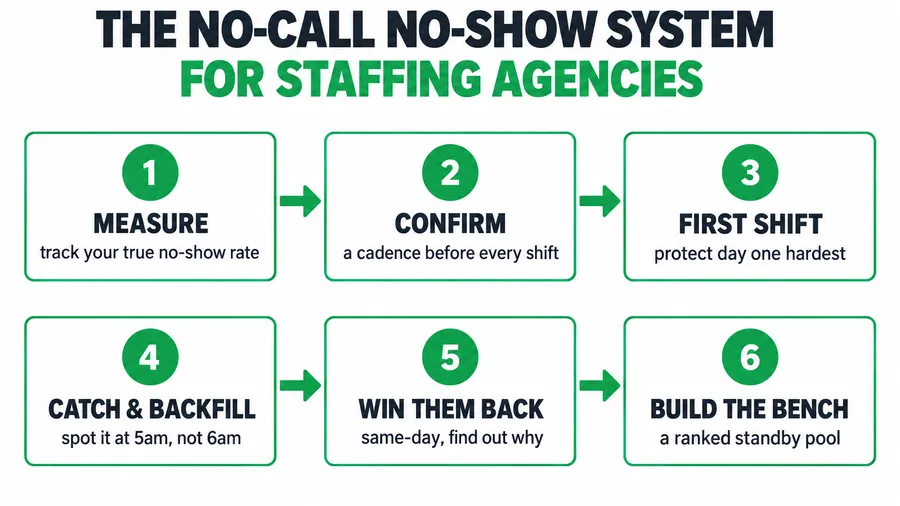
- The submittal-to-decision system, six stages
- Stage 1: Measure where the delay actually is
- Stage 2: Set the feedback window into the job order
- Stage 3: Send a submittal that makes a fast yes easy
- Stage 4: Run the hiring-manager nudge cadence
- Stage 5: Kill the interview scheduling back-and-forth
- Stage 6: Keep the candidate warm, then force the decision
- Three real scenarios: solo, 8-seat, and 25-seat
- Common objections, answered
- FAQ
Why slow client feedback is a staffing problem, not an HR one
Here is the trap most recruiters fall into. When a client sits on a submittal, you tell yourself it is out of your hands. The hiring manager is busy, the decision is theirs, you did your part. That framing feels fair and it is exactly why you keep losing candidates. In a direct-hire or temp desk, you do not get paid for the submittal. You get paid for the placement, and the placement dies in the gap between the two. The client’s delay is not their problem to own. It is your revenue, and if you are not managing that clock, nobody is.
The numbers make it concrete. There are around 27,000 staffing and recruiting companies in the US running close to 54,000 offices, and together they put about 2.2 million temporary and contract employees to work in an average week (American Staffing Association). Nearly all of them compete for the same candidates, which means the moment you submit someone good, you are in a race you cannot see. Your candidate is probably talking to two or three other desks, and the one who gets a decision first wins. Kforce’s survey of 2,500 candidates found that only 21% were willing to wait two weeks for a decision after the first interview, and the recruiter quoted in that same release put it plainly: a good candidate “could be off the market before you hit your second round.”
The other thing that makes this a staffing problem is that your client often does not feel the cost. To them a week of silence is normal. To you, that same week is a candidate going cold, a competitor closing, and a fee evaporating. The job of a good desk is to make your sense of urgency the client’s reality, and you cannot do that by hoping they remember to reply. You do it with a system.
What one lost candidate really costs you
Put a number on a candidate you lose to client delay and you will stop treating it as the cost of doing business. It is three costs stacked, and the third one compounds.
First, the direct cost of the work you already did. Sourcing, screening, the calls, the reference check, the submittal: that is real recruiter time, and SHRM’s 2025 benchmarking put the average cost per hire for nonexecutive roles at $5,475. When a candidate drops out because your client stalled, you eat the cost of that work and then pay it again to source a replacement for a req that is still open.
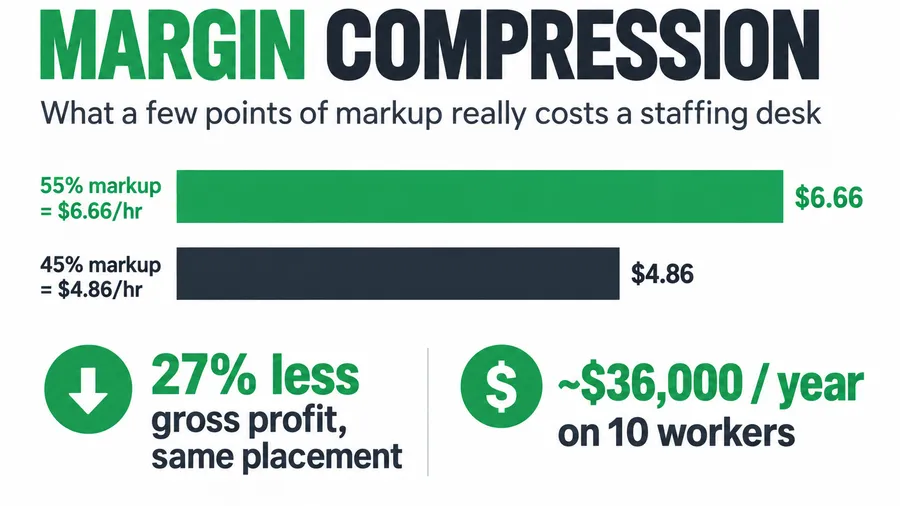
Second, you lose the margin or the fee itself. A contingency recruiter billing 20% on a $65,000 hire just watched $13,000 walk because the hiring manager took nine days to say yes. A light-industrial desk running 50% markup on a filled shift loses every hour that seat sits empty while the client decides, plus the overtime you promise someone else to cover the hole. The placement was earned. The delay unwound it.
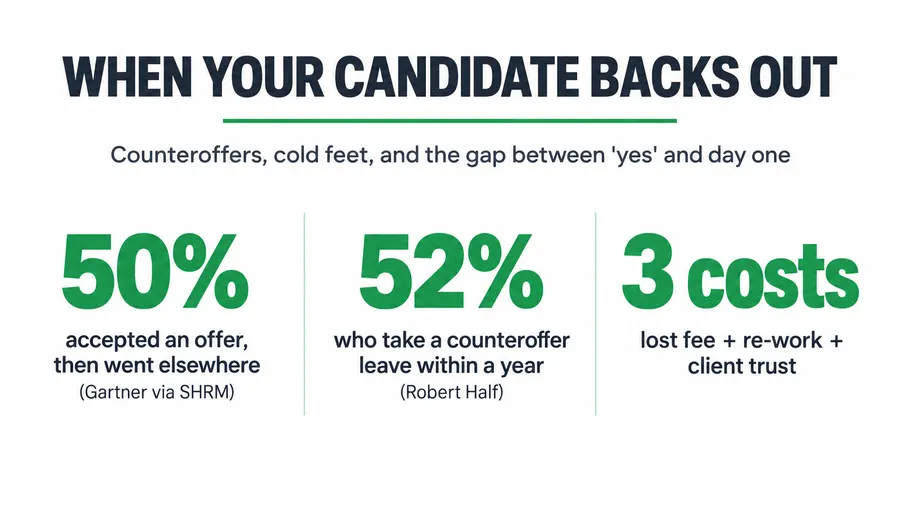
Third, and this is the one that hurts later, the candidate does not just vanish quietly. Robert Half found that when employers go silent, 49% of candidates ghost the company and drop out, 41% blacklist it, and 26% leave an anonymous negative review. In staffing, a burned candidate is not the client’s reputation problem, it is yours, because you are the one who called them, sold them the role, and then went dark. That candidate is now harder to redeploy, less likely to answer your next text, and quietly telling other workers your desk wasted their time. The fee you lost is a number. The candidate relationship you spent is harder to get back.
How fast candidates actually go cold
The reason speed matters is that candidate interest does not decline gently. It falls off a cliff, and the cliff sits right where most client decisions happen. Robert Half found that 62% of professionals lose interest in a job if they do not hear back within two weeks of the initial interview, and 77% have lost interest by three weeks. Kforce measured it even tighter from the candidate’s side: 59% lose interest just one week after the first interview. The window where you still have your candidate is measured in days, not weeks.
Now line that up against how long hiring actually takes. Employ’s 2026 Hiring Benchmarks report put the average time-to-fill at 63.5 days and the time from a candidate’s first interaction to an accepted offer at 46.2 days. Set the candidate’s two-week patience against a 46-day decision process and the math is brutal: the typical process runs three times longer than the typical candidate will wait. The only way you win inside that gap is by compressing the part you can control, which is the stretch between your submittal and the client’s decision. That is the whole game, and the next six stages are how you run it.
The submittal-to-decision system, six stages
Losing candidates to slow clients feels like bad luck when you run the post-submittal period by hope, and it feels like a machine when you run it as stages. The desks that close inside the window are not luckier and they do not have faster clients. They refuse to let the clock run unmanaged. They know where their own delays are, they set expectations before they ever work the req, they make the yes easy, they nudge on a schedule, they remove the scheduling friction, and they keep the candidate warm the whole time. Six stages, in order. Skip one and the rest have to cover for it.
Stage 1: Measure where the delay actually is
You cannot fix a bottleneck you have not located. Most desks “know” their clients are slow the way they know traffic is bad, by feel, which means they cannot tell a client problem from a their-own problem. So measure it. For a rolling month, log two timestamps on every submittal: when you sent it, and when the client gave a clear yes, no, or interview request. That single gap, your submittal-to-decision time, is the number that is costing you candidates, and until you see it you are guessing.
Then split it. Some of that delay is yours: a submittal you sat on, a candidate you took too long to prep, a reference you chased after submitting instead of before. Some of it is the client’s: the manager who travels, the second approver nobody told you about, the “we’re still interviewing” that drags for ten days. You fix those two problems in completely different ways, and lumping them together guarantees you fix neither. Track the split by client too, because one slow account can quietly drag your whole average and your fill rate down. For the broader picture of where a desk leaks days, the playbook on reducing time-to-fill maps the full timeline.
How it breaks. The usual failure is measuring nothing and running on anecdote, so you blame “slow clients” when half the delay is your own submittal lag. The second failure is measuring the average and ignoring the split, which hides the one account that is eating your candidates. A desk that cannot say “my submittal-to-decision time on this client is nine days and six of those are theirs” has no standing to fix it. A desk that can walks into the next conversation with a number instead of a complaint.
Stage 2: Set the feedback window into the job order
The cheapest time to fix a slow client is before they are your client on this req. When you qualify a job order, you are already asking about pay, the role, and must-haves. Add one more line: how fast can you give me feedback on a submittal, and who exactly makes the call? A client who cannot answer that, or who says “whenever we get to it,” is telling you the req will die slowly, and you can decide to deprioritize it or price the risk in. A client who commits to 48 hours has just given you the lever you will use in Stage 4.
Make the feedback window a real term, not a hope. Put it in writing in the engagement: submittals reviewed within two business days, interviews scheduled within three, decisions inside a week. You are not being difficult. You are protecting the client from their own process, because the candidate they want will not survive their normal pace, and framing it that way makes it an easy yes. The exact clauses for this belong in your staffing agency fee agreement, and the full process for pressure-testing a req before you work it is in the guide to qualifying a job order.
Steal this: the feedback-window ask at job-order intake
“Last thing before I start sourcing, and it is the one that actually determines whether we fill this. The people who fit this role are usually talking to two or three other agencies, and good ones are gone inside a week. So I work fastest when I know your side can move too. When I send you a strong submittal, how quickly can you give me a yes, no, or let’s-interview, and who makes that call? If we can agree to feedback inside two business days, I can promise you the first look at the best people. If your process needs longer, that is fine, I just want to set the pace honestly so we both know what we are working with.”
That conversation does two jobs. It surfaces a slow client before you waste a week on them, and it earns you the right to nudge them later without feeling pushy, because they agreed to the pace. The best desks qualify the client’s speed as hard as they qualify the candidate’s fit.
Stage 3: Send a submittal that makes a fast yes easy
A slow decision is often not a slow client. It is a client who cannot decide because you made them do the work. If your submittal is a resume attached to “here’s a candidate for the warehouse role,” you have handed the hiring manager a research project, and research projects sit in the inbox. The fix is to send a submittal that answers the manager’s questions before they ask them, so the only thing left to do is say yes.
Lead with the decision, not the document. Three or four lines at the top: who this is, why they fit this specific req, the one thing that makes them strong, and the one risk you want to be upfront about, because a submittal that admits a flaw is trusted more than one that hides it. Include availability and the pay they expect so there is no back-and-forth. Then make the next step a single click. A manager who can read a four-line summary and reply “yes, book it” in thirty seconds will do it today. A manager who has to open a PDF, cross-reference the req, and compose a reply will do it next week.
Steal this: the decision-first submittal note
“Submitting [Name] for your [role] opening. Quick read:
✅ Fit: [one line on why they match the must-haves, e.g. 3 years on a stand-up reach truck, RF scanner certified, reliable attendance record] ⭐ Standout: [the one thing that makes them better than the stack, e.g. available immediately and lives 10 minutes from the site] ⚠️ Heads-up: [the honest risk, e.g. wants weekends off, so confirm the schedule works] 💵 Looking for: [$X/hr], available to start [date]
They are strong and they are active, so they will not stay available long. Reply YES and I will set up a time, or tell me what is missing and I will keep looking. Can you give me a read by [tomorrow EOD]?”
Notice the last line sets the clock out loud and ties back to the window you agreed in Stage 2. The submittal is not just information. It is a prompt for a decision with a deadline baked in.
How it breaks. The most common failure is burying the decision under detail, so the manager skims, feels unsure, and defers. The other failure is submitting a candidate you have not actually prepped, so when the client does move fast your own side is the one that stalls on availability or pay. Make the yes easy and make sure your candidate is ready to move the second it comes.
Stage 4: Run the hiring-manager nudge cadence
This is the stage that does the heavy lifting, and it is the one almost nobody runs. When a client goes quiet, the recruiter usually does one of two things: nothing, because they do not want to be annoying, or a single frustrated follow-up three days too late. Neither works. What works is a planned cadence of short, useful, escalating nudges that start the moment you submit and do not stop until you have a decision. The point is not to pester. It is to keep your submittal at the top of a busy manager’s pile every single day it sits there, because the manager is not ignoring you, they are drowning, and whoever nudges stays visible.
Run the touches on a schedule, not on your mood. Same day, a confirmation that the submittal landed and a restatement of the deadline. Day one, a value-add nudge that gives the manager a reason to open it. Day two, the urgency nudge that names the competing-offer risk. Day three, the escalation, where you go to your champion or the second contact and make the cost of inaction concrete. Each one is short, each one is easy to reply to, and each one assumes the manager wants to move and just needs the friction removed.
Steal this: the four-touch nudge cadence
Same day (confirmation): “Hi [Name], [Candidate]‘s details are in your inbox. They are strong and active, so to give you the first shot I am holding off on circling back to them. Can you get me a yes, no, or let’s-talk by [tomorrow EOD] like we discussed?”
Day 1 (value-add): “Quick add on [Candidate]: I confirmed they are available to start [date] and [one fresh detail, e.g. they passed the forklift recert last month]. Still your strongest option for this seat. What’s your read?”
Day 2 (urgency): “Heads-up on [Candidate], [Name]. Another agency reached out to them yesterday and they have a second conversation this week. I can protect your first-look through [time] today, after that I cannot promise they are still available. Want me to lock an interview?”
Day 3 (escalation to your champion): “Hi [Champion], I need 60 seconds of help. I sent [Hiring Manager] a strong candidate for the [role] three days ago and have not gotten a decision, and the candidate is now in another process. If this seat still matters, can you nudge the call? I would hate to lose a good fit to timing.”
The escalation on day three is the one that feels uncomfortable and matters most. Going to a second contact or your champion is not going over anyone’s head, it is telling the person who actually feels the open seat that it is about to stay open. Keep every one of these compliant with TCPA consent rules if you are texting, and route them through a system so they fire whether or not you remembered. This cadence is a core part of the broader fill-rate funnel fix.
How it breaks. The nudge cadence dies two ways. The first is relying on a human to run it, so it works on a quiet week and collapses on a busy one, which is exactly the week you have the most submittals out. The second is nagging without adding value, so every touch is “any update?” and the manager starts ignoring you. Give each nudge a reason to exist, space them, and automate the firing so the cadence survives your busiest day. That is precisely the kind of reliable, unglamorous routine software does better than a stressed recruiter, which is why the Hiring Snapshot ships these cadences pre-built on GoHighLevel and why a desk without a dedicated ops person often adds a trained GHL virtual assistant to own the follow-through.
Stage 5: Kill the interview scheduling back-and-forth
You got the yes. Now you lose three days to “what times work for you?” bouncing between the manager, you, and the candidate, and three days is enough for the whole thing to fall apart. Scheduling is pure friction, it adds nothing, and it is completely solvable. The fix is to never trade availability by email again. The moment a client says “let’s interview,” the candidate should be looking at the manager’s real calendar and booking a slot themselves, with confirmations and reminders firing automatically to both sides.
A self-booking link does more than save time. It removes the single most common place a warm deal goes cold, which is the limbo between “yes, let’s talk” and an actual confirmed time on two calendars. It also makes you look like the most organized agency the client works with, because while your competitors are still playing email tag, your candidate is already confirmed for Thursday at 2. Set it up once and every future interview on every req runs itself.
Steal this: the instant-scheduling handoff
To the candidate, the second the client says yes: “Great news, [Client] wants to meet you. Pick a time that works right here: [booking link]. It shows their real availability, so whatever you grab is locked in and you’ll both get a reminder. Grab the earliest slot you can, the faster you meet the better your odds.”
To the client, same moment: “Sent [Candidate] your interview link, they are booking now and you’ll get a calendar invite the second they pick a slot. No scheduling emails needed. I’ll make sure they show up prepared.”
How it breaks. The one failure here is a scheduling tool that does not sync to the manager’s actual calendar, so it offers times that are already booked and you are back to email tag with an extra step. Connect it to the real calendar, add automatic reminders so the interview itself does not no-show, and the friction is gone for good. The reminder cadence that cuts interview no-shows is its own system, covered in the interview no-show recovery playbook.
Stage 6: Keep the candidate warm, then force the decision
Everything so far compresses the client’s clock. This stage buys you time on the candidate’s. While the client decides, your candidate is sitting in silence, and silence is exactly what makes them drift to the competitor who is calling them every day. The fix is to not go dark on your side even when you have nothing new to report, because a candidate who hears from you feels chased, and a chased candidate waits longer. You cannot make the client faster every time, but you can make your candidate more patient, and that is often the difference.
Run a light warm-keep cadence on the candidate that mirrors your client nudges. A same-day “you’re submitted, here’s what happens next,” a check-in a day or two later that is honest about the wait, and the moment you sense a competing offer, the escalation that forces your client’s hand. That last move is the most valuable lever you have: a real competing offer, used honestly, turns a slow maybe into a same-day yes more often than anything else, because now the client feels the clock you have been feeling all along. The full playbook for holding a candidate through the risky window, including counteroffers, is in the guide to what to do when a candidate backs out, and the systemic view of where candidates leak is in why recruiters lose candidates.
Steal this: the warm-keep and the competing-offer escalation
To the candidate, day 1 after submittal: “Hi [Name], you’re in front of [Client] and I’m on them for a fast answer. These things sometimes take a couple of days on their end, so hang tight, I’m pushing. If anything changes on your side, another offer, a question, cold feet, tell me first so I can help, okay?”
To the client, the moment a competing offer is real: “Important update on [Candidate], [Name]. They just told me they have a written offer from another company and need to respond by [day]. They would rather take your role, I can tell, but I cannot ask them to turn down a real offer for a maybe. Can you give me a yes and an interview time today, or a firm offer by [day]? If we move now we keep them. If we wait, we lose them. Your call, but it’s a today call.”
That message works because it is true and it is specific. You are not inventing pressure, you are reporting a real deadline, and you are giving the client a clear, binary, time-boxed choice. Used honestly it is the single best tool for turning client delay into client urgency. Used as a bluff it burns your credibility, so only ever run it when the offer is real.
How it breaks. The warm-keep fails when you go silent because you have “no news,” which reads to the candidate as “they forgot about me” and pushes them toward whoever is still calling. No news is still a touch: tell them you are pushing. The escalation fails when you cry wolf. Save it for a real competing offer, deliver it as a report rather than a threat, and it works almost every time.
Three real scenarios: solo, 8-seat, and 25-seat
The system is the same at every size. The pressure point moves.
The solo contingency recruiter, perm placements, 20 to 25% fees. You are the bottleneck and the fix. One lost candidate can be a month of income gone, and you have no volume to absorb it, so your whole game is Stages 2 and 4: set a feedback window with every client before you work the req, and run the nudge cadence religiously even when you are slammed, because when you are slammed is exactly when submittals die in inboxes. You do not have an ops person, so the cadence and the scheduling have to run on their own or they will not run at all. A single self-booking link and an automated four-touch nudge is the highest-impact thing a solo desk can install, because it clones the one follow-up discipline you cannot keep up manually while you are also sourcing.
The 8-recruiter light-industrial agency, temp and temp-to-hire, 40 to 80% markup. Here the problem is volume plus speed. You are submitting dozens of candidates a week across many clients, the window is tight because temp workers take the first real shift offered, and manual follow-up simply does not scale to that many open loops. Stages 3, 4, and 5 carry the weight: a decision-first submittal template every recruiter uses, an automated nudge cadence firing per submittal so no loop goes quiet, and universal self-scheduling so no interview waits on email. Track Stage 1 by client so the one slow account that is eating your fill rate becomes visible instead of hiding in the average. This is the desk the system was built for, because the leak here is death by a hundred unmanaged clocks.
The 25-recruiter healthcare or high-volume shop. At this scale, submittal-to-decision time is a managed metric, not a feeling. A two-day improvement in your average across hundreds of submittals is real revenue and a real fill-rate gain, and the Stage 1 data becomes a client-by-client scorecard you use in quarterly reviews: “your average decision time is eight days, the market is three, and here is what it cost both of us.” The nudge cadence and warm-keep are standardized and automated across the whole team so quality does not depend on which recruiter owns the req, and the scheduling layer is wired into your ATS. The asset at this size is the data, because when you can show a client exactly how their slowness is costing them talent, you either fix the account or you reprice it.
Common objections, answered
“The decision is the client’s. I can’t make them move faster.” You cannot force a signature, but you absolutely shape the pace, and pretending you cannot is how you keep losing candidates. Setting a feedback window at intake, sending a submittal that makes a yes a thirty-second task, nudging on a schedule, and reporting a real competing offer are all things that move a client’s timeline, and none of them require authority over the client. You are not making the decision for them. You are removing every reason to delay it. The desk that does this closes inside the window. The desk that shrugs and blames the client watches candidates walk.
“Won’t all these nudges annoy the hiring manager?” Not if each one is short and adds something. A nudge that says “any update?” is annoying. A nudge that says “confirmed they can start Monday, still your strongest option, need a read by EOD” is useful, and busy managers are grateful for the recruiter who keeps the decision in front of them instead of letting it rot. The line is value and spacing: give every touch a reason to exist, keep it brief, and tie it to the pace the client agreed to. Done right, the manager sees you as the organized agency, not the pushy one.
“My clients would never agree to a feedback deadline.” Some will not, and that is useful information, not a dead end. A client who refuses any commitment to speed is telling you this req will be slow and your candidates will die in it, so you can price that risk, deprioritize the account, or at least stop blaming yourself when it does not fill. Most clients, though, say yes when you frame the window as protecting them: the person they want will not wait, so moving fast is how they win talent, not a favor to you. You are not demanding. You are aligning your urgency with their goal.
“I already follow up with clients.” Most desks that say this mean they send a reminder or two when they remember, which is better than nothing and nowhere near a system. The difference is a cadence that fires on schedule whether or not you are busy, each touch planned to add value and escalate, a self-scheduling link that removes the dead time after the yes, and a parallel warm-keep on the candidate so they do not drift while they wait. “I follow up” is a habit that collapses under a heavy week. A cadence that runs itself is infrastructure that holds.
“Do I really need software for this? My recruiters can send texts.” They can, right up until a busy week has thirty submittals out across a dozen clients, each needing a same-day confirmation, a day-one value nudge, a day-two urgency touch, a day-three escalation, and a candidate warm-keep on its own clock, and a human becomes the single point of failure. The wins here are boring and automatable: fire the touches on schedule, surface the submittals with no decision, send the self-booking link the instant the client says yes, and alert a recruiter when a competing offer lands. That reliable, unglamorous follow-through is exactly what a person does well for a week and then drops, which is why these cadences come pre-built in the Hiring Snapshot and plug in front of the GoHighLevel recruiting pipeline most desks already underuse.
FAQ
Why do I keep losing candidates even when my sourcing is good?
Usually because the candidate goes cold in the gap between your submittal and the client’s decision, not because you found the wrong person. Good candidates are talking to several desks at once, and interest decays fast: Kforce found 59% lose interest just one week after the first interview, and Robert Half found 62% are gone by two weeks of silence. If you are not actively managing the time between “submitted” and “decided,” a slow client will lose your candidate for you, no matter how strong your sourcing was.
How fast do candidates lose interest in a job?
Faster than most hiring processes move. Robert Half found 62% of professionals lose interest if they do not hear back within two weeks of the first interview, rising to 77% at three weeks, and Kforce put the one-week figure at 59%. Against that, Employ’s 2026 benchmarks show an average of 46.2 days from first interaction to accepted offer. The process typically runs three times longer than the candidate will wait, which is why the stretch you control, submittal to decision, is where placements are won or lost.
How do I get a hiring manager to respond to my submittals faster?
Set a feedback window when you take the job order, send a decision-first submittal that makes a yes a thirty-second task, and run a short, scheduled nudge cadence that adds value each time instead of just asking for updates. Confirm the submittal landed the same day, add a fresh detail on day one, name the competing-offer risk on day two, and escalate to a second contact on day three. When a real competing offer appears, report it honestly with a deadline, which turns a slow maybe into a same-day decision more reliably than anything else.
Is slow client feedback really my problem as the recruiter?
On your profit-and-loss statement, yes. You are not paid for the submittal, you are paid for the placement, and the placement dies in the delay. The client often does not feel the cost of a week of silence, but you feel all of it: a candidate going cold, a competitor closing, and a fee evaporating. Managing the client’s pace is not overstepping, it is protecting revenue you already earned by doing the sourcing.
What does losing a candidate to client delay actually cost?
Three stacked costs. The recruiter time you already spent sourcing and screening, which SHRM’s 2025 benchmarking pegs near a $5,475 average cost per hire for nonexecutive roles. The fee or margin itself, which can be five figures on a single perm placement. And the candidate relationship, because Robert Half found 49% of candidates who get ghosted drop out entirely and 41% blacklist the company, which makes that worker harder to place next time too.
Can automation fix slow client feedback without annoying anyone?
Yes, when the automation sends useful, well-spaced touches rather than robotic “any update?” pings. A system like GoHighLevel can fire the submittal confirmation, the value-add nudge, the urgency touch, and the escalation on schedule, send a self-booking link the instant the client agrees to interview, and run a candidate warm-keep in parallel, each tied to the pace the client agreed to at intake. That keeps the decision visible and the candidate engaged without a human having to remember, which is exactly when manual follow-up fails.
About the author
Adrienne Boyd is the Recruiting Automation Strategist behind the Hiring Snapshot. She spent a decade building applicant-capture funnels and SMS-first nurture cadences for staffing agencies before moving full-time into GoHighLevel automation. She writes the playbooks and field reports, and she is happiest when a manual, three-person follow-up process collapses into a single trigger that never forgets to nudge.