· Marcus Delgado · Growth · 24 min read
Staffing Agency Cash Flow: How to Cover Payroll When Clients Pay Net-60
You pay your temps every Friday and your client pays you in 60 days. That gap is the real business you are running. Here is the six-stage system that keeps payroll funded, from credit-checking a client to deciding whether factoring is worth its fee, with the exact copy and math.
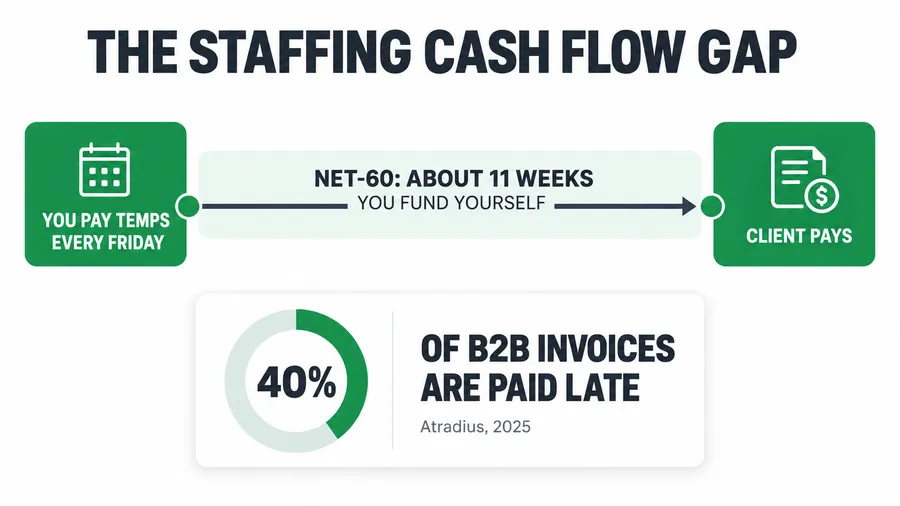
It is Thursday afternoon and payroll runs tomorrow. Twenty-two temps worked this week, your gross payroll is a little over $19,000, and the money to cover it has to leave your account in the morning. The client those workers are placed at is a good client. They also pay net-60. So the invoice you send tonight will not turn into cash in your bank until late November. You are not short on business. You are short on the eight weeks between doing the work and getting paid for it, and that gap is the actual business you run.
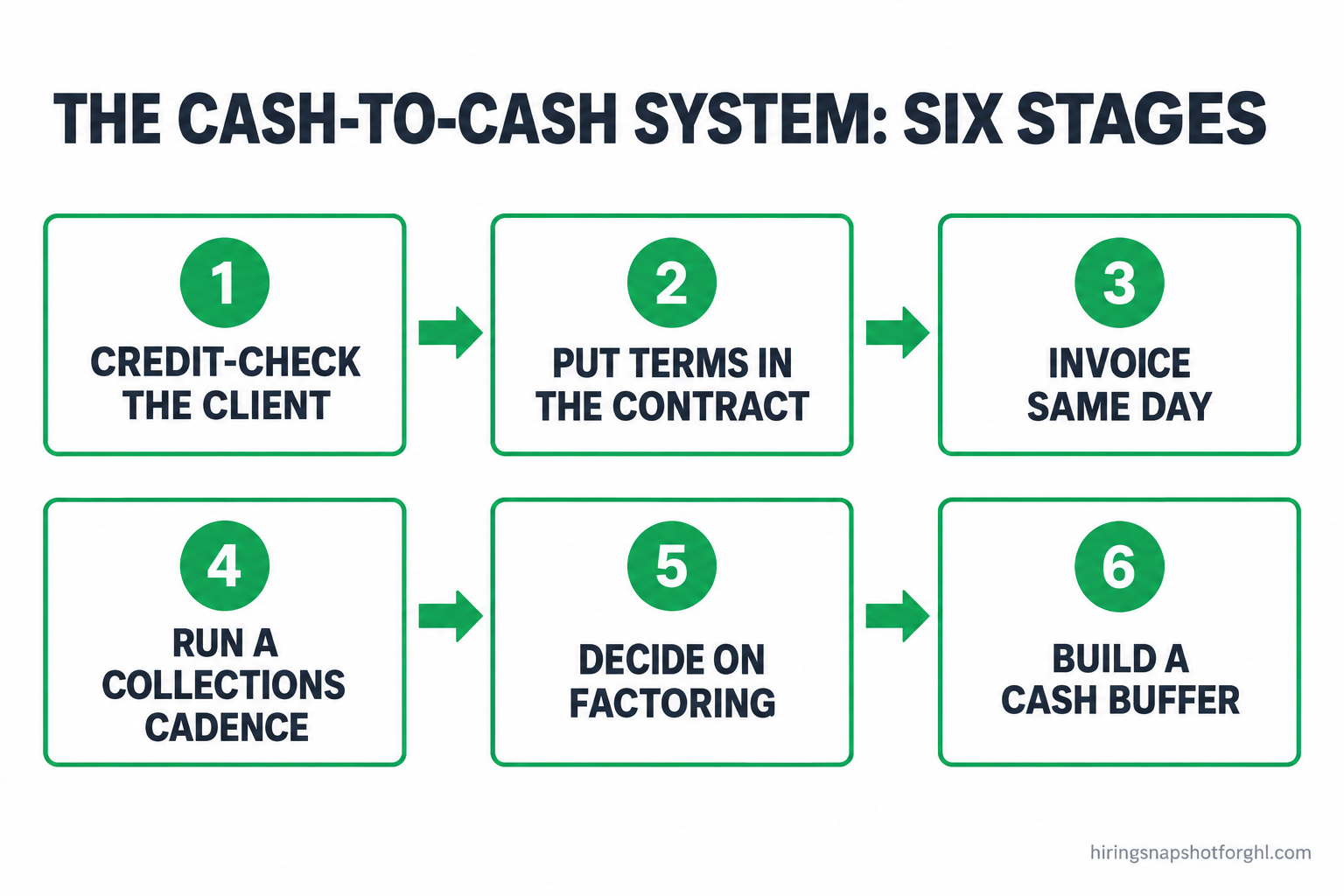
The short answer: a staffing desk survives net-60 by treating cash flow as a system, not a scramble. Credit-check the client before you place anyone, put payment terms and a late fee in writing, invoice the same day the timesheet clears, work a collections cadence that starts before the invoice is due, and decide deliberately whether payroll funding or factoring is worth its fee for that account. Do those five things in order and the gap stops being the thing that wakes you at 3am. This is the whole cash-to-cash system, with the real numbers, the copy you can steal, and the traps that sink desks that wing it.
Key takeaways
- You pay workers weekly; clients pay in 30, 60, or 90 days. On net-60 terms, plan to self-fund roughly 10 to 12 weeks of payroll per active account, because real days-to-pay almost always runs past the contract term.
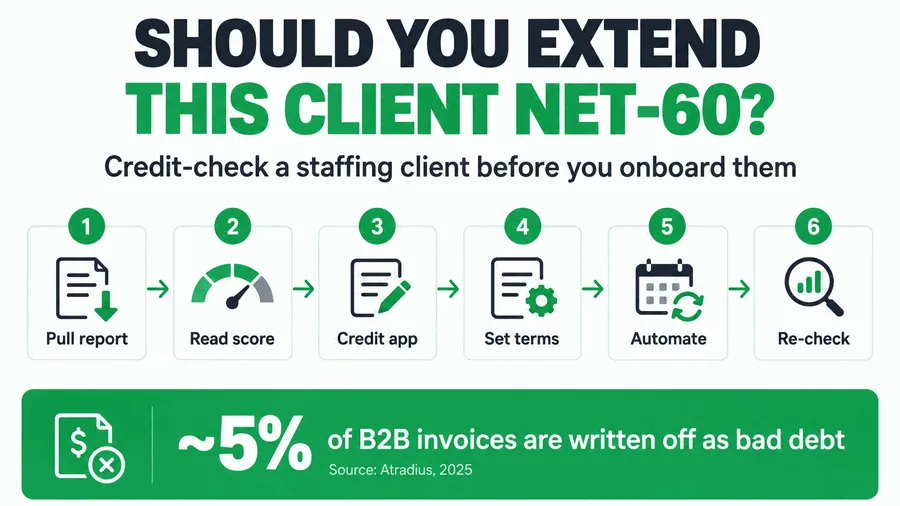
- Late payment is normal, not rare. About 40% of North American B2B invoices are paid late and roughly 5% are written off as bad debt (Atradius, 2025). Your terms and collections are what keep you out of that 5%.
- Factoring buys time, and it is not free. Staffing factors typically advance 80% to 95% of an invoice and charge about 1.5% to 3% per 30 days. On net-60 money, that is real margin.
- Credit-check the client before the first shift. A one-time business credit report runs from about $40 to $150. A bad-debt write-off on a full requisition costs a great deal more.
- Fast, clean invoicing is free money. Every day you shave off the invoice-to-cash clock is a day you do not have to fund. Same-day billing and an automated follow-up cadence do more for cash than any loan.
Table of contents
- The gap that quietly runs your agency
- The cash-to-cash system, six stages
- Stage 1: Credit-check the client before the first shift
- Stage 2: Put the terms in the contract, not in your head
- Stage 3: Invoice the same day, and invoice clean
- Stage 4: Work a collections cadence before the invoice is late
- Stage 5: The factoring decision, and what it really costs
- Stage 6: Build the buffer so you stop depending on the factor
- Three real scenarios: solo, 8-seat, and 25-seat
- The traps hiding in a factoring agreement
- Common objections, answered
- FAQ
The gap that quietly runs your agency
There are roughly 27,000 staffing and recruiting companies in the United States running about 54,000 offices, and together they put around 2.2 million temporary and contract workers to work in an average week (American Staffing Association). Almost every one of those desks lives on the same timing mismatch. The temp gets paid weekly because that is how temp work works. The client pays on the terms they dictated, usually net-30, often net-45, and increasingly net-60. You cover the middle.
Put a number on it. A light-industrial desk running 22 workers at a $19,000 weekly gross payroll on net-60 terms carries eight to nine weeks of that payroll out of pocket at any moment, and the practical planning number runs higher because days-to-pay drifts past the term. Advance Partners, a payroll-funding firm, tells staffing clients to plan for about 10 to 12 weeks of cash coverage on net-60. At $19,000 a week that is up to $228,000 of your own money tied up in one account before you have banked a cent of its margin. Grow the account and the gap grows with it. That is why staffing agencies can be busy, profitable on paper, and still run out of cash. Growth eats cash in this business.
The late-payment reality makes it worse. Around 40% of North American B2B invoices are paid after the due date, and roughly 5% of receivables get written off as bad debt entirely (Atradius Payment Practices Barometer, 2025), while US B2B days-sales-outstanding averages in the mid-40-day range and drifts higher for slower industries (CreditPulse, 2025). So the net-60 client is rarely a net-60 payer. They are a net-72 payer who signed a net-60 contract, and the extra twelve days are funded by you.
The cash-to-cash system, six stages
Cash flow feels like luck when you run it by feel and like a machine when you run it as stages. The desks that never sweat payroll are not the ones with rich clients. They are the ones who close the gap at every step: they let fewer bad payers in, they invoice faster, they chase earlier, and they use financing on purpose instead of in a panic. Six stages, in order. Skip one and the others work harder to cover for it.
Stage 1: Credit-check the client before the first shift
The cheapest bad debt is the one you never take on. Before you place a single worker at a new client, pull a business credit report. Dun and Bradstreet, Experian Business, and Creditsafe all sell them, and a one-time report runs from roughly $40 to about $150 depending on provider and depth (US Chamber of Commerce); Creditsafe often gives you one free. That is nothing against funding eight weeks of payroll for a client who was never going to pay.
You are looking for three things: how they pay other suppliers, whether there are liens or judgments, and how long they have been trading. A brand-new company with no payment history that wants net-60 and forty workers on Monday is not a lucky break, it is the profile that turns into a write-off. That does not mean you say no. It means you place them on tighter terms, net-15 or a deposit, until they have earned longer ones.
How it breaks. The classic failure is skipping the check because the client is a referral or a big name. Big names are the slowest payers in the business, because they can be, and a referral tells you the client is nice, not that they are solvent. The other failure is checking once and never again. If a client’s crew suddenly grows and their payments slow at the same time, that is a warning, not an opportunity.
Steal this: the terms-setting line for a new client
“Happy to get your crew started Monday. For a first engagement we run net-15 for the first 30 days, then move to net-30 once we have a payment history together. If your team needs longer terms up front, we can do that against a signed credit application and a quick trade reference check. Which works for you?”
That single message does three jobs. It sets a defensible default, it makes longer terms conditional on information you want anyway, and it frames the credit check as routine rather than an accusation. Nobody reasonable objects to it.
Stage 2: Put the terms in the contract, not in your head
A payment term you did not write down is a term the client sets later. Your staffing agreement needs four things spelled out, and most agencies are missing at least two.
First, the net term and the clock. State the number of days and, more importantly, when the clock starts. “Net-30 from invoice date” and “net-30 from receipt of approved timesheet” are very different, because the second lets a client stall the clock by sitting on approvals. Tie the term to invoice date and require timesheet disputes within a fixed window.
Second, a late fee. A 1.5% monthly service charge on past-due balances is standard and enforceable in most commercial contracts. You will rarely collect it. Its job is to give you something to waive as goodwill while you get the real balance paid, and to signal that you watch your receivables.
Third, who approves hours and how. Name the client contact who signs off timesheets and the deadline for doing it. Half of all late payments trace back to a slow or missing approval, not a refusal to pay.
Fourth, for larger or riskier accounts, a personal guarantee or deposit. If a small client wants forty workers on net-60, a signed personal guarantee from the owner changes what happens if the company folds. It is a normal ask for a large exposure.
How it breaks. The common trap is winning the account on a handshake and a rate, then learning at invoice time that the client “always pays net-60” and nothing in writing says otherwise. The other is a contract that sets net-30 from invoice date but an invoice you cannot send until the client slowly approves hours. Now your net-30 is really net-45 and you wrote it yourself.
Steal this: the payment-terms clause
“Payment terms are net-30 from invoice date. Client agrees to review and approve or dispute submitted timesheets within two (2) business days of receipt; timesheets not disputed within that window are deemed approved. Past-due balances accrue a service charge of 1.5% per month. Agency reserves the right to suspend services on any account more than 15 days past due.”
Read that last line twice. The right to suspend a past-due account is the most powerful clause in a staffing contract, because your workers are the client’s operation. Use it rarely, but have it.
Stage 3: Invoice the same day, and invoice clean
Every day between the work happening and the invoice landing is a day you fund for free. It is the cheapest cash improvement you own, and most desks leave it on the table because billing is a Friday-afternoon chore that slips to Monday, then Wednesday.
Same-day is the standard. The timesheet clears, the invoice goes out that day, the clock starts that day. On a net-60 account, invoicing three days late is not a rounding error, it is three more days of payroll you carry on every invoice, forever. Across a year of weekly invoices that is weeks of extra funding you chose to eat.
Clean matters as much as fast. A disputed invoice does not start the clock, it pauses it, and the client is under no pressure to resolve a dispute they benefit from. So the invoice has to match the approved hours exactly, carry the client’s PO or reference number, name the workers and dates, and go to the person who actually pays, not the site manager who approved the hours. Get it wrong and you have handed the client a free reason to wait until next month.
How it breaks. Two ways, constantly. The invoice sits because billing is manual and nobody owns Friday, or it bounces because it does not match the PO, went to the wrong contact, or lists a worker the client already queried. Both are process failures, not client failures, and both are fixable with a billing routine that fires approved timesheets automatically instead of waiting for a human. If billing is the bottleneck, a trained virtual assistant running your desk operations or an automated invoicing workflow pays for itself in funded weeks alone.
Stage 4: Work a collections cadence before the invoice is late
Collections is not the angry call on day 65. By day 65 you are already funding twelve extra weeks and the client has learned you do not chase. Real collections starts before the invoice is even due, and stays polite the whole way through. The goal is to be the supplier whose invoice gets paid first, because you are the one clearly paying attention.
Here is the cadence that works on net-30. Shift the day numbers for longer terms but keep the shape: a friendly confirmation early, a reminder before due, a prompt on the due date, and a firm but calm escalation after.
Steal this: the collections cadence (net-30)
Day 1, email, invoice sent: “Hi [Name], attached is invoice [#] for the week ending [date], $[amount], due [date]. Everything on it matches the hours [approver] approved. Let me know if you need anything to process it.”
Day 20, email, gentle reminder: “Hi [Name], quick heads-up that invoice [#] for $[amount] is due [date]. If it is already in your payment run, ignore this. If you need a PO number or a second copy, I will send it over today.”
Day 30, text and email, due today: “Hi [Name], invoice [#] for $[amount] is due today. Can you confirm it is scheduled for payment this week? Happy to resend if it is stuck anywhere.”
Day 33, phone call, past due: the call script below.
Day 40, email, firm: “Hi [Name], invoice [#] is now 10 days past due. Per our agreement a 1.5% service charge applies to past-due balances, though I am glad to waive it if we can get this settled this week. Can you tell me the date it will be paid?”
The phone call on day 33 is where money actually moves, so script it and keep it warm.
Steal this: the past-due call script
“Hi [Name], it’s [You] from [Agency]. I’m calling about invoice [#] for $[amount], which was due Monday. I wanted to check there’s nothing holding it up on your end, a missing PO, a timesheet question, anything like that. [Listen.] Great, so if there’s nothing blocking it, can we get it into this week’s payment run? Can you confirm the date it’ll go out? I’ll drop you a note with that date so we’re both covered.”
Notice what the script does. It assumes a fixable problem rather than an accusation, it hunts for the real blocker, and it ends by pinning a specific date and confirming it in writing. “We’ll pay you soon” is not a commitment. “It will be paid Thursday” is. Get the date, log the date, follow up on the date.
Stage 5: The factoring decision, and what it really costs
Sometimes the gap is bigger than your cash, and you finance it. The most common tool in staffing is invoice factoring, also sold as payroll funding. You sell your unpaid invoice to a factor, they advance most of it within a day or two, and when the client pays they release the rest minus their fee. Approval hinges on your client’s credit, not yours, which is why a young, growing agency with strong clients can use it (Crestmont Capital).
Know the two numbers before you sign. The advance rate is how much you get up front, typically 80% to 95%, and higher, around 90% to 97%, when your clients are large or government-backed. The fee or discount rate is what it costs, usually about 1.5% to 3% per 30 days the invoice stays open (Crestmont Capital, Charter Capital). That per-30-day detail is the whole game on net-60 money, because a fee quoted “per 30 days” doubles on an invoice that takes 60 days to pay.
Run it on the real payroll. On a single $19,000 weekly invoice, a 2% fee for the first 30 days is $380, and if the client takes the full 60 days you are closer to $760 on that one invoice. Do that every week and factoring costs a meaningful slice of gross margin. Weigh that against what the cash buys: making payroll without stress, taking on a big account you could not otherwise fund, and not personally guaranteeing a bank line. For a desk in a growth spurt, that trade is often worth it. For a stable desk sitting on cash, paying 2% to 3% a month to borrow against your own money is expensive habit, not strategy. Factoring is a tool for the growth phase, not a permanent tax.
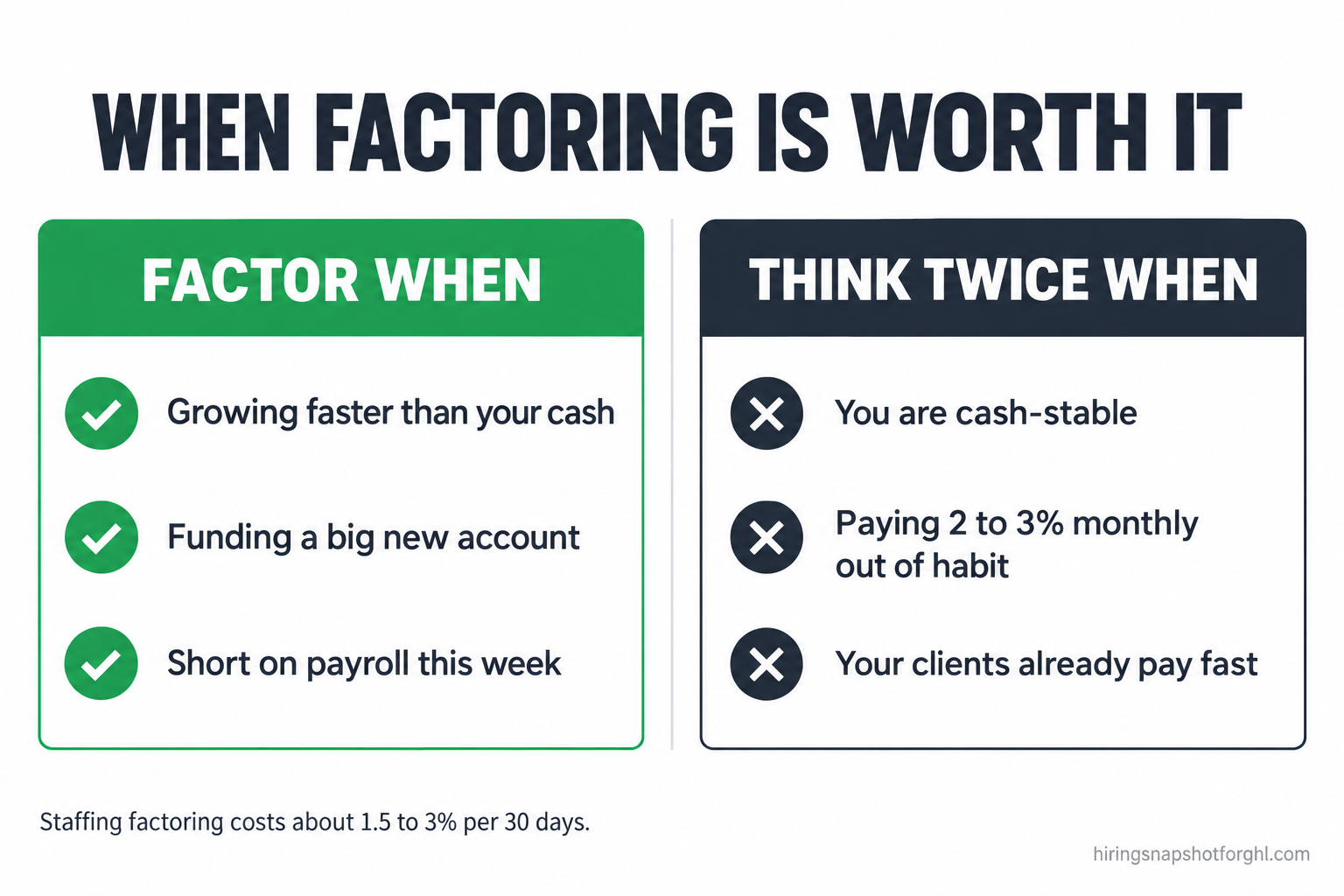
How it breaks. Agencies get burned three ways with factoring. They factor everything, including fast-paying clients they never needed to finance, and hand away margin for nothing. They sign a long contract with monthly minimums that force them to keep factoring after they no longer need to. Or they misread recourse: on a recourse deal, if the client never pays, the debt bounces back to you, so factoring is not the same as buying insurance against a deadbeat client. Read the traps section below before you sign anything.
Stage 6: Build the buffer so you stop depending on the factor
The endgame is not to factor forever. It is to build enough of a cash buffer that financing becomes a choice for big new accounts rather than a lifeline for ordinary weeks. Three unexciting levers get you there.
Protect margin, because margin is where the buffer comes from. Markup is not margin, and payroll burden quietly eats a chunk of the spread before you keep anything, so know your real gross-margin math cold and defend it against rate pushback. That math, walked through in the staffing bill rate and markup guide, decides whether a placement funds your buffer or drains it.
Keep good workers deployed. A redeployed contractor is placement margin with none of the sourcing cost, and it smooths the revenue gaps that push you to the factor between assignments; the mechanics of turning one placement into three are in the contractor redeployment playbook.
Bank the repeat clients who pay well. A client who pays on time at a healthy margin is worth two who pay net-75 and grind your rate, and shifting your book toward the good ones is the slow compounding win covered in how repeat-client revenue grows. Fewer bad payers, more good ones, protected margin: that is a buffer, built on purpose.
Three real scenarios: solo, 8-seat, and 25-seat
The system is the same at every size. The pressure point moves.
The solo contingency recruiter, perm placements, 20 to 25% fees. You have the easiest cash position in staffing, so guard it. You invoice a placement fee and run no weekly payroll, so you have no funding gap, only a collection risk. Your whole cash-flow job is Stages 1 through 4: credit-check the client before you work the search, put the fee, the term, and a fallback clause in the contract, invoice the day the candidate starts, and chase politely until it clears. Never factor a placement fee. Do get the terms right, because a single unpaid 22% fee on a senior hire is a month of income.
The 8-recruiter light-industrial agency, temp and temp-to-hire, 40 to 80% markup. This is where the gap bites hardest. You run weekly payroll, clients push net-45 and net-60, and every account you win makes the funding hole deeper before it makes you richer. All six stages are live. Credit-check hard, hold your terms, invoice same-day without fail, and treat factoring as a deliberate tool for the accounts growing faster than your cash. Price the fee into whether a big net-60 account is worth taking, because sometimes the honest answer is that it is not, at that markup.
The 25-recruiter healthcare or high-volume shop. Here the cash gap is a seven-figure number and a finance function, not a chore. You likely run a factoring or payroll-funding line as standing infrastructure, and the work is managing it well: keeping the advance rate high with strong client credit, minimizing the fee by collecting fast so invoices do not sit, and negotiating the funding contract like the material cost it is. At this scale a half-point off your rate is real money, and clean, fast, automated invoicing is what earns it.
The traps hiding in a factoring agreement
A factoring contract is a financial product, and the fee on the front page is not where the cost hides. Before you sign, get clear answers on five things.
Recourse versus non-recourse. On a recourse agreement, the most common kind, an invoice the client never pays comes back to you and you repay the advance. Non-recourse shifts some of that credit risk to the factor, but only for defined events like client insolvency, and it costs more. Know which one you are signing, because recourse factoring does not protect you from a client who folds.
Notice of assignment. The factor will usually tell your client to pay them directly. That is normal, but it means your client knows you factor and some read it as a sign of trouble, so ask how the factor communicates with your customers.
Minimums and term length. Many contracts carry monthly minimum volumes and multi-year terms with early-termination fees. That is how a tool for your growth phase becomes a cost you cannot shed. Push for a short initial term and no minimum, or price the minimum in.
Which invoices. Factoring only your slow-paying accounts is smart. Being required to factor your whole book, fast payers included, is expensive. Confirm you can pick.
The all-in rate. Ask for every fee: the discount rate plus any origination, wire, monthly service, or minimum charges, expressed as one all-in cost. The teaser rate and the effective rate are often not the same number, and that is worth an afternoon before you sign a multi-year deal.
Common objections, answered
“Can’t I just push my clients to net-30 and skip all this?” Ask, always, because some will say yes and every day you shorten the term is cash you stop funding. But in a lot of light-industrial and healthcare work the large clients dictate terms and net-60 is the price of the account. When you cannot move the term, you manage the gap with the stages above. The real win is getting the terms right on the accounts you can influence, which is covered in the client-acquisition playbook.
“Isn’t factoring a sign my agency is in trouble?” No, and this myth costs growing desks real opportunities. Factoring is credit-based on your clients, so it is common precisely among healthy agencies growing faster than their cash can keep up. The trouble sign is not using it, it is needing it every week on stable accounts with no plan to build a buffer.
“Do I really need software for invoicing and collections? I have a spreadsheet.” You need the routine to be reliable, and a spreadsheet depends on a human remembering it every Friday, which is what fails under pressure. The wins are boring and automatable: invoice the day hours clear, send the reminder before due, fire the past-due sequence on schedule. That is why the Hiring Snapshot ships the billing triggers and follow-up cadences pre-built rather than as an empty account, and why a desk without a dedicated ops person often adds a trained GHL virtual assistant to run it. The cadence runs whether or not anyone remembers it.
“My client pays fine, so why credit-check them?” Because “pays fine” describes the past, and exposure is about the future. A client that pays fine on ten workers is a different risk on forty, and one that paid fine last year can be in trouble this year. A periodic re-check is cheap insurance on your biggest accounts, which are also your biggest write-off risk if they turn.
FAQ
How do staffing agencies pay employees before clients pay them?
They fund the gap out of their own cash, a line of credit, or invoice factoring. Temp workers are paid weekly while clients pay on net-30 to net-90 terms, so the agency covers payroll first and collects later. On net-60 terms an agency should plan to self-fund roughly 10 to 12 weeks of payroll per active account, because actual days-to-pay usually runs past the contract term. The tools to manage it are faster invoicing, tighter collections, and factoring when growth outpaces cash.
What is invoice factoring for a staffing agency and what does it cost?
Factoring is selling your unpaid client invoices to a finance company that advances most of the value up front, usually 80% to 95%, and releases the rest when the client pays, minus a fee of about 1.5% to 3% per 30 days the invoice stays open. Approval is based on your clients’ credit rather than yours. On a net-60 invoice the per-30-day fee roughly doubles, so a 2% rate can cost close to 4% by the time a slow client pays.
How do I get a client to pay faster?
Set the term in writing tied to invoice date, invoice the same day hours are approved, and run a collections cadence that starts before the invoice is due rather than after it is late. A reminder a few days before due, a prompt on the due date, and a warm phone call a few days past due move far more money than an angry email at day 60. Always end a collections call by pinning a specific payment date and confirming it in writing.
Should I run a credit check on a new staffing client?
Yes, before you place anyone. A one-time business credit report from Dun and Bradstreet, Experian, or Creditsafe costs roughly $40 to $150, and Creditsafe often has a free report. It tells you how the client pays other suppliers and whether there are liens or judgments, so you can set net-15 or a deposit for a shaky payer and reserve net-60 for clients who have earned it. The cost of the report is trivial against funding payroll for a client who never pays.
Is net-60 normal in staffing, and can I avoid it?
Net-60 is common, especially with large light-industrial and healthcare clients who use their size to dictate terms, and it is spreading. You can push new or smaller clients toward net-30 and you should, but with large accounts net-60 is often the cost of the business. When you cannot shorten the term, price the funding cost into the account and decide whether the margin still works. Sometimes a net-60 account at a thin markup is not worth taking.
Does factoring protect me if a client never pays?
Not usually. Most staffing factoring is recourse, which means an invoice the client never pays comes back to you and you repay the advance. Non-recourse factoring shifts some credit risk to the factor, but only for specific covered events like client insolvency, and it costs more. Read which type you are signing, because recourse factoring buys you speed, not protection against a bad debt.
About the author
Marcus Delgado is the Staffing Agency Growth Lead behind the Hiring Snapshot. He ran a light-industrial staffing desk before joining the team to focus on agency growth, and he thinks in placement economics: fill rates, redeploys, and gross margin per requisition. His posts lean on real desk math, not vanity metrics.
Related reading
- Staffing Agency Bill Rate & Markup: The Margin Math That Keeps a Desk Profitable
- Contractor Redeployment: The Automation That Turns One Placement Into Three
- How Repeat-Client Revenue Goes from 20% to 60% in 18 Months
- How to Get Clients for a Staffing Agency: The 2026 Client-Acquisition Playbook
- Staffing Industry Benchmarks 2026: The Recruiting Metrics That Actually Matter