· Marcus Delgado · Growth · 23 min read
How to Run a Credit Check on a Staffing Client Before You Onboard Them (2026)
You pay your temps this Friday. Your new client pays you in 45 days, if they pay at all. Before you float six weeks of payroll for a business you have never billed, here is the six-stage vetting system that tells you who gets net-60, who gets a deposit, and who you should walk away from.
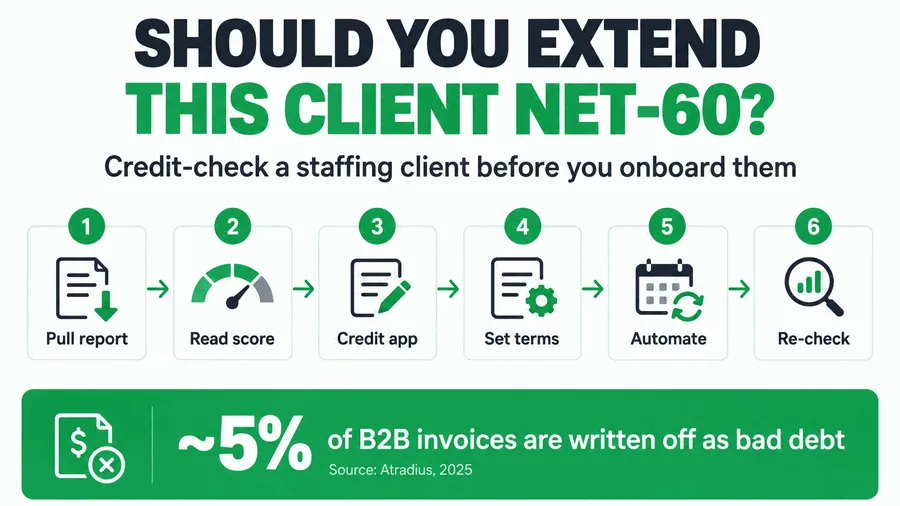
A warehouse manager calls on a Tuesday. He needs thirty pickers for a new contract, he needs them Monday, and he wants net-45 terms because “that is how we do it with all our vendors.” It is the kind of call that makes a slow month. You place the thirty workers, you run payroll every Friday at about $27,000 gross, and you send the first invoice feeling good about the win. Then the invoice ages. Day 45 comes and goes. Day 60. The phone calls start going to voicemail. By the time you find out the parent company filed for bankruptcy protection, you have funded six weeks of payroll for a client who was never going to pay, and that one account just erased a quarter of profit from every other desk in the building.
The short answer: you never onboard a staffing client on open terms until you have credit-checked the business, because the money you float is real and the client’s promise is not. Pull a business credit report, read it for how they actually pay other suppliers, collect a signed credit application with trade references, then set payment terms to the risk you measured instead of the volume you want. Do that in order and a shaky client becomes a net-15 client instead of a write-off. This is the whole vetting system, with the real report costs, the exact copy to send, and the traps that sink desks that place first and check never.
Key takeaways
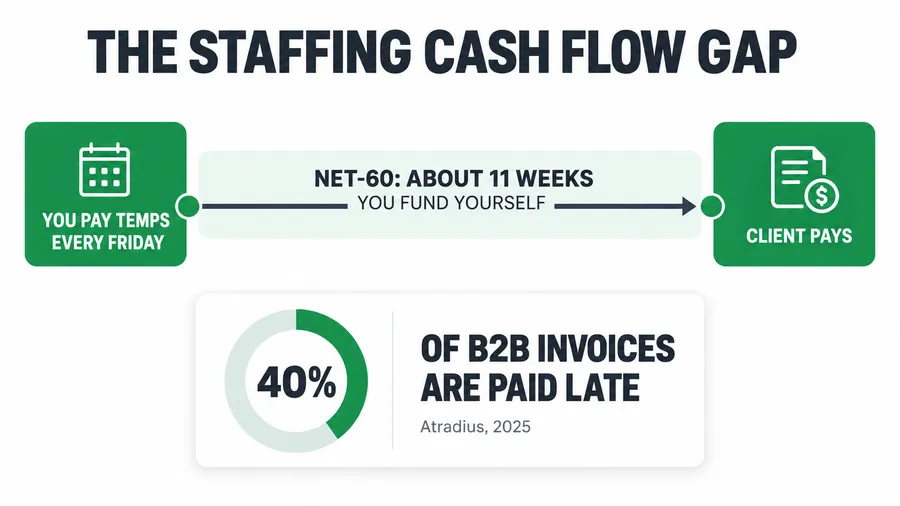
- The work is done before the money arrives. On net-60 terms you self-fund roughly 10 to 12 weeks of payroll per active account, so a client who never pays costs you the payroll, not just the margin.
- Late and unpaid is the norm, not the exception. About 40% of North American B2B invoices are paid late and roughly 5% are written off as bad debt (Atradius, 2025). Vetting is how you stay out of the 5%.
- A report costs about $40. A bad requisition costs five figures. A one-time Experian business report runs $39.95 to $49.95, and Nav and Creditsafe offer free business credit summaries. That is nothing against funding payroll for eight weeks.
- Read the score, then set the term. A D&B PAYDEX of 80 means the business pays on the day due; below 50 is high risk. Match the term to the tier: deposit or net-15 for risky, net-30 to earn trust, net-60 only once earned.
- Re-check the clients you already carry. US commercial bankruptcy filings rose 5% in 2025 to 31,810 (ABI, 2026). A client who paid fine last year is a different risk this year.
Table of contents
- Why one unvetted client can wipe out your year
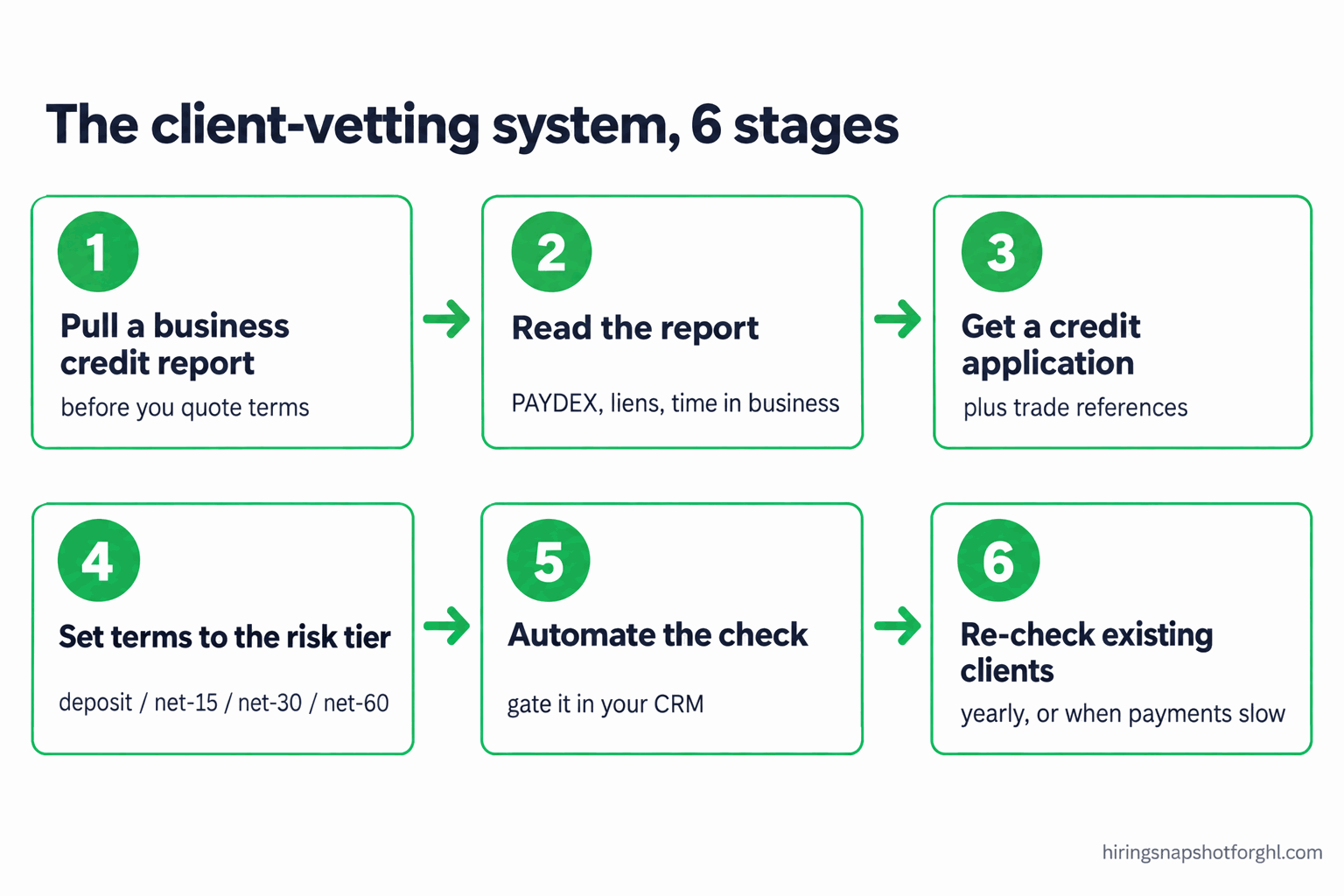
- The client-vetting system, six stages
- Stage 1: Pull a business credit report before you quote terms
- Stage 2: Read the report like an operator, not a banker
- Stage 3: Get a signed credit application and trade references
- Stage 4: Set the term to the risk tier you measured
- Stage 5: Automate the check so it never gets skipped
- Stage 6: Re-check the clients already on your book
- Three real scenarios: solo, 8-seat, and 25-seat
- The legal line: what a business credit check is and is not
- Common objections, answered
- FAQ
Why one unvetted client can wipe out your year
There are roughly 27,000 staffing and recruiting companies in the United States running about 54,000 offices, and together they put around 2.2 million temporary and contract workers to work in an average week (American Staffing Association). Nearly every one of those desks lives on the same exposure. You pay the worker weekly because that is how temp work runs. The client pays you on terms they dictated, and in the gap between the two, you are lending the client money whether or not you meant to. A credit check is just deciding, on purpose, how much you are willing to lend and to whom.
The reason it matters is that non-payment is common. Around 40% of North American B2B invoices are paid after the due date, and roughly 5% of receivables are written off as bad debt entirely, with US days-sales-outstanding sitting near 47 days (Atradius Payment Practices Barometer, 2025). Those are not rare events on the far tail. One in twenty dollars of what businesses are owed simply never shows up, and in staffing that dollar was already paid out to a worker. The write-off is not lost margin. It is lost cash you fronted.
It is also getting riskier, not safer. US commercial bankruptcy filings rose 5% in 2025 to 31,810, part of an 11% jump in total filings to 565,759 for the year (American Bankruptcy Institute, 2026). More of the companies calling you for workers are under real financial pressure than were a couple of years ago, and the ones in the most trouble are often the ones in the biggest hurry to staff up. A brand-new company that wants forty workers on Monday and net-60 terms is not always a lucky break. Sometimes it is a business trying to run one more month on someone else’s money, and you are the someone.
Put the cost in numbers your desk understands. A single write-off on thirty workers at a $27,000 weekly gross that ran six weeks before it went bad is more than $160,000 of payroll you funded and will not recover. The business credit report that would have flagged it costs about forty dollars. That is the entire trade of this article: forty dollars and twenty minutes against a five- or six-figure hole.
The client-vetting system, six stages
Vetting a client feels like paperwork when you do it by feel and like protection when you run it as stages. The desks that never eat a big write-off are not the ones with rich clients. They are the ones who decide terms from evidence instead of enthusiasm: they pull the report before they quote, they read it for the signals that matter in staffing, they get the client’s own paperwork on file, and they price the risk into the terms. Six stages, in order. Skip the early ones and the late ones cannot save you.
Stage 1: Pull a business credit report before you quote terms
The moment to check a client is before you have promised anything, because once you have said “sure, net-45,” taking it back feels like an accusation. Pull the report while the deal is still being scoped and the terms conversation is still open.
You have real options at every price. A one-time business credit report from Experian runs $39.95 for the score report and $49.95 for the fuller profile with tradelines and inquiries. Dun and Bradstreet reports cost more, often over $100 for a detailed pull, but carry the deepest trade history. Nav gives you a free business credit summary across bureaus, and Creditsafe often provides a report at no cost to prospects. For a smaller client you are considering for net-15 or net-30, the free summary is usually enough. For a large exposure on longer terms, pay for the full D&B or Experian profile. It is the cheapest insurance you will buy all year, and the range of $40 to $150 is trivial next to one bad requisition.
How it breaks. The classic failure is checking the wrong entity. The manager who calls you works for a location, but the legal payer might be a holding company, a franchisee, or a staffing MSP sitting between you and the real employer. Pull the report on the business whose name goes on the invoice, get the exact legal name and address on the credit application, and confirm who actually cuts the check. The second failure is not checking at all because the client is a referral or a recognizable name. Big names are frequently the slowest payers in the business, because their size lets them be, and a referral tells you the client is pleasant, not that they are solvent.
Stage 2: Read the report like an operator, not a banker
A business credit report is not a pass-fail. It is a picture of how this company treats the people it owes money, and you are about to become one of them. Three things matter more than the rest.
First, the payment score. Dun and Bradstreet’s PAYDEX runs 1 to 100. A score of 80 means the business pays, on average, on the exact day an invoice is due; scores above 80 mean it pays early, and the bands below tell the story fast: 80 to 100 is low risk, 50 to 79 is moderate risk, and anything under 50 signals a real history of paying late (Dun and Bradstreet). Experian’s Intelliscore Plus also runs 1 to 100 but is a risk model, so it reads the other way: 76 to 100 is low risk down to 1 to 10 as high risk (Nav). Learn which scale you are looking at before you react to the number.
Second, the derogatory signals. Liens, judgments, and UCC filings are the ones that should slow you down. A UCC filing is a public record that a lender has a security interest in the company’s assets, and a stack of them, especially from cash-advance funders, is a sign of a business borrowing expensively to stay afloat. Tax liens and civil judgments mean other creditors have already had to fight to get paid. You do not need a perfect record, but you need to know what is there.
Third, time in business and trade lines. A company trading for eight years with a dozen tradelines that all report on-time is a very different risk from a six-month-old entity with no history that wants forty workers now. Thin file plus long terms plus urgency is the exact profile that turns into a write-off.
How it breaks. Reading only the headline score and ignoring the derogatory section is the common mistake. A decent score with three recent judgments is not a decent client. The other trap is treating a thin file as automatically bad. A new company is not a bad company, it is an unknown one, so you manage the unknown with a deposit or short terms rather than a flat no. Unknown gets tighter terms. Bad gets a polite pass.
Stage 3: Get a signed credit application and trade references
The report tells you how the client pays the world. The credit application tells you how they will pay you, and it puts the terms in writing before there is anything to argue about. A simple one-page application should capture the exact legal entity name and billing address, the accounts-payable contact and their direct email, the requested terms, two or three trade references you can call, and, for a larger exposure, a personal guarantee from an owner.
Trade references are worth the ten-minute phone call. Ask each reference three questions: how long the client has bought from them, what terms they extend, and whether the client pays on time. A reference who hesitates on the last one is telling you everything. References the client hand-picked will skew positive, which is fine, because a client who cannot produce even three suppliers willing to vouch for their payment is a client without a payment history at all.
Steal this: the credit-application request email
“Great talking through the req. To get your crew started and set up billing on our side, I just need a quick credit application, it takes about five minutes. It confirms the billing entity and AP contact, and it lets us set your payment terms up front so there are no surprises on the first invoice. I have attached it, along with a W-9 and our COI. Send it back and I will have your account and terms confirmed same day.”
That frames the application as onboarding, not interrogation. Every real company you want to work with fills it out without blinking.
How it breaks. The trap is treating the application as optional for “obvious” clients and mandatory only for small ones, which is backwards, because your biggest exposure is your biggest account. The other failure is collecting the form and never calling the references. An unread application is a filing exercise. The reference calls are where a shaky client quietly disqualifies themselves.
Stage 4: Set the term to the risk tier you measured
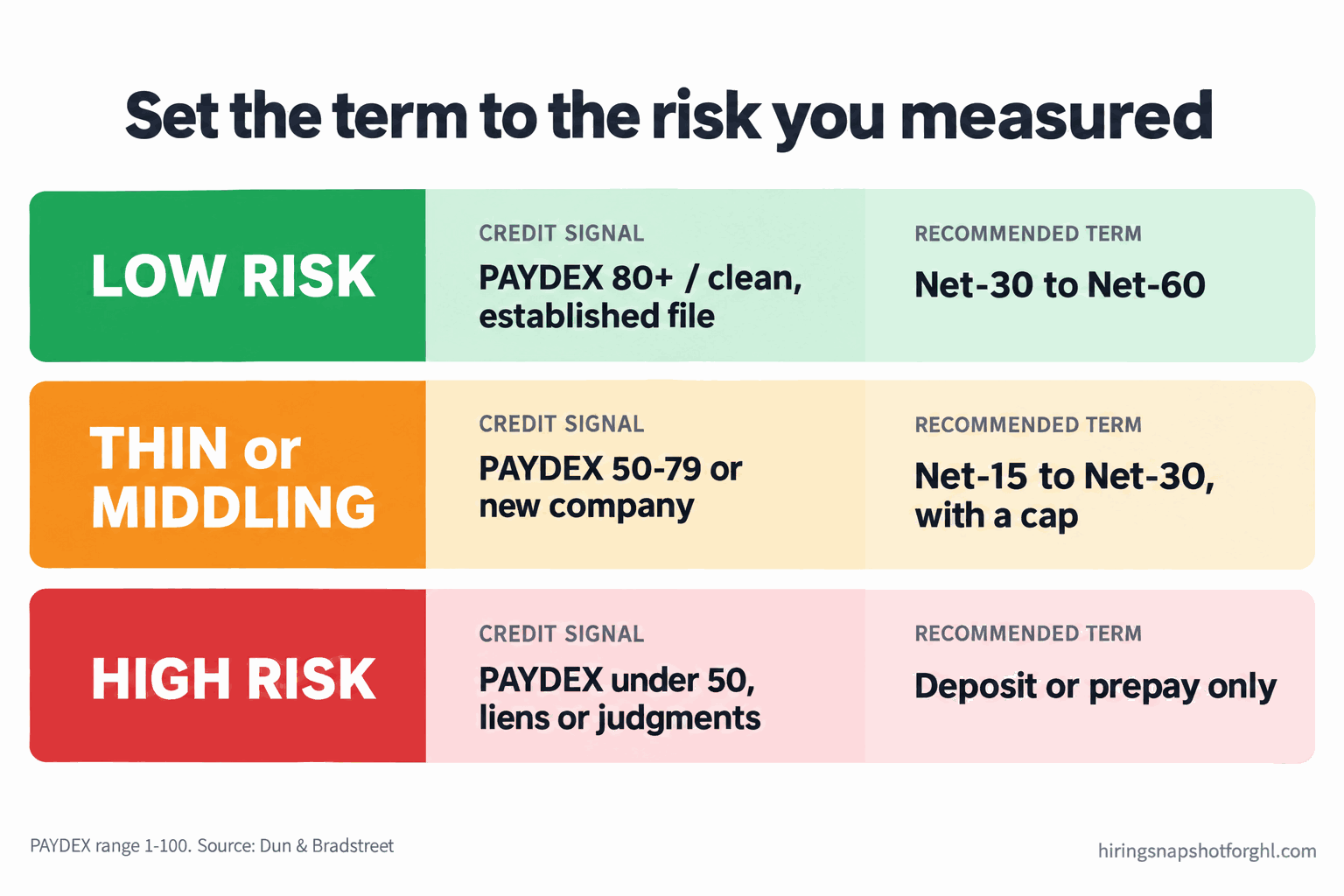
Everything so far exists to answer one question: what terms do you offer? The answer is a tier, not a gut feeling. Sort every new client into one of three buckets and let the bucket set the term.
Green, established and paying well. PAYDEX 80 or higher, or an Experian low-risk band, a clean derogatory section, and years of trade history. These clients earn net-30, and the large, well-rated ones can have net-60 if the account margin covers the funding cost. This is where you compete on terms to win good business.
Amber, thin or middling. A newer company, a moderate score, or a file with a small blemish but no pattern. Start them at net-15 or a modest net-30 with a credit cap, meaning you only carry so much exposure at once, and move them to longer terms after 60 to 90 days of clean payment history with you. You are not saying no, you are saying “earn it.”
Red, real warning signs. A score under 50, active liens or judgments, or a thin file that wants long terms and high volume immediately. These clients work on a deposit, weekly prepay, or not at all. If the account is big enough to matter, a personal guarantee from the owner changes what happens if the company folds, and it is a normal ask for a large first-time exposure.
Steal this: the terms line for an amber client
“Happy to get your crew started Monday. For a first engagement we run net-15 for the first 60 days, then move to net-30 once we have a payment history together. If your team needs longer terms up front, we can set that against a signed credit application and a quick trade-reference check. Which works for you?”
That single message sets a defensible default, makes longer terms conditional on information you want anyway, and frames the whole thing as routine. Nobody reasonable pushes back on it. Once a client is onboarded and paying, the rest of the cash-flow work, from same-day invoicing to a collections cadence, is covered in the net-60 cash-flow playbook, and the bill-rate and markup math tells you whether a net-60 account is even worth carrying at your margin.
Stage 5: Automate the check so it never gets skipped
A vetting step that depends on a busy recruiter remembering it under deadline pressure is a step that gets skipped on exactly the rushed, high-volume deals where it matters most. The fix is to make the check part of the intake flow, not a favor to your future self.
In practice that means a new-client intake form that a recruiter fills the moment a prospect is real, which fires a task to pull or request the report, holds the account in a “terms pending” stage until the credit application is back, and only then lets the client move to “active” with a risk tier tagged on the record. The recruiter never has to remember the policy, because the pipeline will not advance without it. This is straightforward to build inside a GoHighLevel recruiting pipeline, and if you would rather not build it, a trained GHL virtual assistant can run intake and reference calls for you, or a custom client-portal build can collect the application and W-9 without a single email thread.
How it breaks. The failure is a policy that lives in your head and a pipeline that lets anyone skip it. The rushed Monday-morning placement is where the discipline breaks, so the discipline has to be in the system rather than in a person’s memory. Build the gate once and it protects every deal, including the ones you would have waved through.
Stage 6: Re-check the clients already on your book
Vetting is not a one-time gate at onboarding. A client who checked out clean two years ago can be in real trouble today, and the first sign is often that a steady payer starts stretching from net-30 to net-45 without a word. With commercial bankruptcies up 5% in 2025, the account you trust most is also your largest single write-off risk if it turns.
Two habits cover it. Re-pull a report on your top few accounts once a year, or whenever an account’s volume jumps or its payments start slowing, whichever comes first. And watch your own aging: a client whose days-to-pay is drifting month over month is telling you something before any report does. When you see it, that is the moment to quietly tighten terms or ask for a partial prepay on new volume, not after the invoice is 90 days late.
How it breaks. The trap is loyalty. The client who has paid fine for three years feels like family, so nobody wants to run a check or hold a line. But “paid fine” describes the past, and your exposure is entirely about the future. A polite re-check is cheap insurance on the accounts that would hurt the most.
Three real scenarios: solo, 8-seat, and 25-seat
The framework holds at every size, but what it looks like in practice changes with the desk.
The solo contingency recruiter. You place a handful of workers at a time and you do not have a finance function, so keep it lean. Pull the free Nav or Creditsafe summary on every new client, ask for a one-page credit application on anyone who wants more than net-15, and call one trade reference on your larger placements. Your whole risk-management program is twenty minutes per new client, and at your volume a single write-off is not a bad quarter, it is a threat to the business. Vetting is not overhead for you. It is survival.
The 8-seat light-industrial desk. Here you are carrying real exposure across a dozen active clients and a rushed placement is a weekly event, so the win is consistency. Standardize a one-page credit application, set the three-tier terms policy in writing so every recruiter quotes the same way, and put the intake gate in your CRM so no account goes active without a check. Pay for the full Experian or D&B report on any client you are extending net-30 or beyond. The goal is that the newest recruiter on your team vets a client exactly the way you would.
The 25-seat healthcare or high-volume agency. At this scale credit risk is a portfolio, and one large client can represent six figures of standing exposure. Run reports as standing policy, set credit caps per client so no single account can grow past a limit without review, re-check your top accounts on a schedule, and tie your terms directly to your funding. If you factor or use payroll funding, your advance rate and fee are priced on your clients’ credit anyway, so strong client vetting literally lowers your cost of money. At this size, a half-point saved on funding because your book is clean is real profit, and it starts at intake.
The legal line: what a business credit check is and is not
Vet clients confidently, but know the boundary. Pulling a business credit report on a company is commercial credit information and is not governed by the Fair Credit Reporting Act, which protects consumers, not businesses. You do not need a company’s permission to pull its business credit file, the same way a supplier does not need yours.
The line you can cross is the personal guarantee. The moment you ask an owner to personally guarantee the account and you check their personal credit, you are pulling a consumer report, and now the FCRA applies: you need the individual’s written authorization, and if you decline them or offer worse terms because of that report, you owe a proper adverse-action notice. Keep the two clearly separate. A business credit pull is routine and needs no consent; a personal-credit pull on a guarantor needs written permission and a compliant process. This is a different subject from candidate background checks, which are FCRA-covered consumer reports and carry their own disclosure and consent rules, and it is worth keeping your client-credit process and your candidate-screening process in separate lanes so the consent requirements never blur.
Common objections, answered
“Won’t asking for a credit check offend a good client?” A good client has been through this before and expects it, because every serious supplier who extends terms does the same thing. What offends clients is not being asked for a credit application, it is a billing dispute three months in because terms were never set. Frame it as onboarding and it lands as professionalism, not suspicion. The clients who bristle at a routine credit application are, more often than not, exactly the ones the check would have flagged.
“I already know this client. Why check them?” Because knowing someone tells you they are nice, not that their company is solvent, and those are different facts. Plenty of write-offs come from clients the agency liked and trusted, whose business was quietly failing while the relationship stayed warm. The check is not a judgment on the person. It is a snapshot of the company’s finances, which the person may not fully see either.
“I’m a solo recruiter. Isn’t this overkill?” It is the opposite. A large agency can absorb one bad account across a big book. A solo desk that funds six weeks of payroll for a non-payer can be finished by it. The smaller you are, the less you can afford a single write-off, so the more a forty-dollar report and a ten-minute reference call earn their place. Overkill is funding payroll for a stranger on a handshake.
“What if a client refuses to fill out the application?” That is information, and usually the most useful you will get. A legitimate company that wants an ongoing staffing relationship completes a standard credit application without drama. A prospect who refuses, stalls, or gets defensive about a routine form is showing you how the payment conversations will go later. You do not have to walk away, but you should move them to a deposit or prepay until they are willing to put the basics in writing.
FAQ
Should a staffing agency run a credit check on a new client?
Yes, before you place a single worker on open terms. On temp and contract work you pay employees weekly while the client pays in 30, 60, or 90 days, so you are financing the client whether you intend to or not. A one-time business credit report costs roughly $40 to $150, and free summaries are available from Nav and Creditsafe. It shows how the client pays other suppliers and whether there are liens or judgments, so you can set a deposit or net-15 for a shaky payer and reserve net-60 for clients who have earned it. The report cost is trivial against funding weeks of payroll for a client who never pays.
How do I check a business’s credit before extending payment terms?
Pull a business credit report from Dun and Bradstreet, Experian, or Creditsafe on the exact legal entity that will be billed, and read it for the payment score, any liens or judgments, and how long the company has traded with a clean history. Then collect a signed one-page credit application that captures the billing entity, the accounts-payable contact, and two or three trade references you actually call. The report tells you how they pay the world; the references and application tell you how they will pay you and put the terms in writing before the first invoice.
What business credit score is good enough to extend net-60 terms?
On the Dun and Bradstreet PAYDEX scale, 80 or higher means the business pays on or before the due date and is low risk; 50 to 79 is moderate; under 50 is high risk. On Experian’s Intelliscore Plus, 76 to 100 is the low-risk band. A clean score alone is not enough, though. Extend net-60 only to a well-rated client with no active liens or judgments, a multi-year trade history, and an account whose margin can carry roughly 10 to 12 weeks of funding. A high score on a thin, brand-new file still warrants shorter terms until the client proves out with you.
Do I need a client’s permission to run a business credit check?
No. A business credit report covers commercial credit information and is not governed by the Fair Credit Reporting Act, which protects consumers, so you can pull a company’s business credit file without its consent. The exception is a personal guarantee: if you check an owner’s personal credit to back the account, that is a consumer report, and you then need the individual’s written authorization and must send an adverse-action notice if you decline or offer worse terms based on it. Keep business-credit pulls and personal-credit pulls in separate, clearly documented lanes.
How much does a business credit report cost?
A one-time report runs roughly $40 to $150 depending on the bureau and depth. Experian’s small-business reports are about $39.95 for the score and $49.95 for the fuller profile with tradelines, Dun and Bradstreet detailed reports often run over $100, and Nav and Creditsafe offer free business credit summaries that are enough for smaller, shorter-term exposures. Pay for the full report when you are extending net-30 or beyond or carrying a large exposure, and use the free summaries for quick, low-risk checks.
How often should I re-check clients I already work with?
At least once a year on your largest accounts, and immediately whenever an account’s volume jumps or its payments start slowing. A client who checked out clean two years ago can be under real pressure today, and with US commercial bankruptcies up in 2025 the risk is rising, not falling. Watch your own aging report too: a steady payer whose days-to-pay is drifting from net-30 toward net-45 is warning you before any bureau does, and that is the moment to tighten terms or ask for prepay on new volume.
About the author
Marcus Delgado is the Staffing Agency Growth Lead behind the Hiring Snapshot. He ran a light-industrial staffing desk before joining the team to focus on agency growth, and he thinks in placement economics: fill rates, redeploys, and gross margin per requisition. His posts lean on real desk math, not vanity metrics.
Related reading
- Staffing Agency Cash Flow: How to Cover Payroll When Clients Pay Net-60
- Staffing Agency Bill Rate & Markup: The Margin Math That Keeps a Desk Profitable
- How to Get Clients for a Staffing Agency: The 2026 Client-Acquisition Playbook
- How to Use GoHighLevel as an ATS: Build a Recruiting Pipeline That Fills Reqs Faster
- Staffing Industry Benchmarks 2026: The Recruiting Metrics That Actually Matter